Star STEM Teacher Grants: Meet the Educators Bringing Hands-On STEM Projects to Life
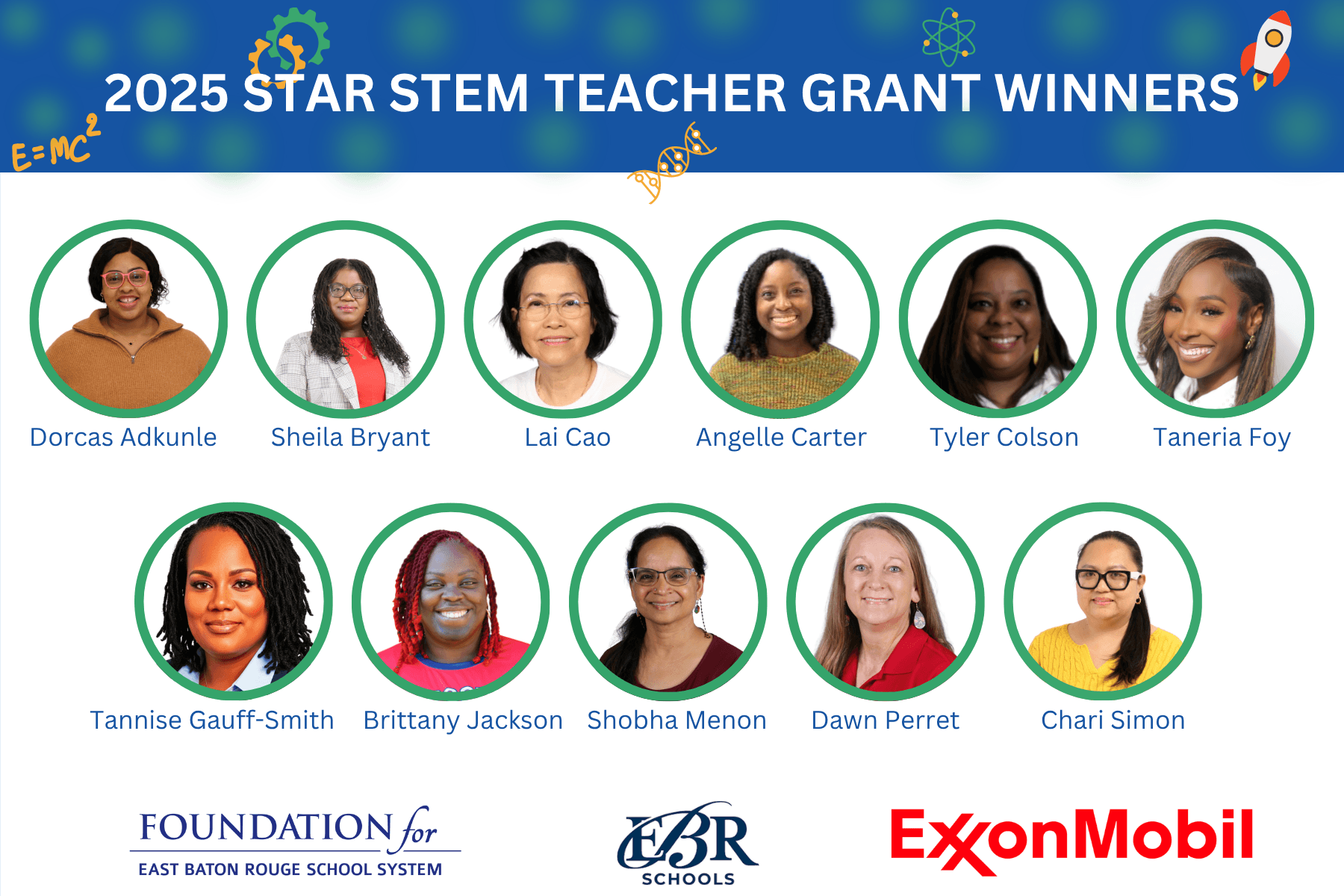
This fall, 11 talented educators from EBR Schools, teaching grades 4–12, were awarded Star STEM Teacher Grants, supported by ExxonMobil and the Foundation for East Baton Rouge School System. These grants provided funding for hands-on STEM projects that actively engaged students in science, technology, engineering, and math. With the support of our partners and donors, these teachers will begin bringing their innovative projects to life in early 2026, creating meaningful learning experiences that deliver measurable impact for students and the community. Here’s a closer look at a few of the projects in action.
Meet Dorcas Adekunle from Woodlawn Middle
Project Title: Solar Oven STEM Challenge : A Hands-On Renewable Energy Experience for 8th Graders
Project Description: Her students will design and build solar ovens, then test them by cooking food, turning science class into a hands-on engineering lab.
Students Impacted: 50 Science students will benefit from this grant
Enhancing Education: Our students live in a world facing big challenges: climate change, energy use, and environmental sustainability. This project gives them the chance to explore those topics not just in theory, but through hands-on problem-solving. They’ll learn how solar energy can be a clean, renewable source of power ; and how science and engineering can help us rethink how we cook, build, and live. It also builds real skills: teamwork, critical thinking, creativity, data analysis, and communication.
Meet Lai Cao from Baton Rouge Magnet High
Project Title: Real Life Applications of Physics
Project Description: She will make STEM come to life through hands-on physics investigations. Students will explore Newton's laws and energy transfer by building car models to test collision forces and designing energy-efficient houses.
Students Impacted: 160 High School Students
Enhancing Education: Most students, especially girls and students from low-socio-economic families whose parents may not be familiar with the term “STEM”, do not see physics (or STEM) as practical, relevant, or “doable” for them. Physics studies, particularly evidence-based models, are often perceived as expensive projects reserved for more privileged groups of students. These challenges affect students’ confidence, self-esteem, and academic performance. Without access to technological lab equipment, students struggle to connect physics concepts, such as energy efficiency, to their daily lives or recognize them as potential career opportunities. By bringing these concepts to life through accessible, hands-on experiences, this project will empower students to see themselves as capable scientists, creators, and problem-solvers.
Meet Angelle Carter from Capitol Elementary
Project Title: The Living Laboratory - STEM in the Schoolyard
Project Description: She is turning an outdoor space into a STEM lab. Students will design raised bed gardens, track plant growth and engineer compost bins and irrigation systems.
Students Impacted: Approximately 25 students in grades 3-6 will directly participate in weekly garden sessions
Enhancing Education: The garden integrates hands-on learning with state science and math standards. Students will apply geometry and measurement to garden planning, explore ecosystems and photosynthesis, test innovative irrigation designs, and use digital tools to collect and analyze data. By engaging multiple senses and real-world problem-solving, the garden deepens conceptual understanding and sparks lifelong interest in STEM and agricultural careers.
Meet Tyler Colson from Park Forest Middle
Project Title: Water Quality at Blackwater Conservation Area
Project Description: Her students will test water quality at a local conservation area and use their findings to propose a safety plan for their community.
Students Impacted: 50 students
Enhancing Education: This project will enhance scientific inquiry in a real neighborhood problem. Currently, our students are learning about phase change of water and chemical reactions. This project serves as an extension of this learning because they will be able to directly see how water's cyclical process changes properties as it rains, encounters runoff, and condenses. Students will also use their knowledge of chemical reactions to test water quality and see how chemicals that have encountered groundwater affect people. Students will perform as actual scientists. They will make hypothesis about the safety of the water, test, draw conclusions, and propose a plan to stakeholders.
Meet Taneria Foy from EBR Readiness High
Project Title: Unlocking Life’s Code: Hands-On Genetics & Microbiology Exploration
Project Description: Her students will dive into genetics and microbiology, extracting DNA from fruits, culturing bacteria safely and exploring cell structures under microscopes.
Students Impacted: This project will directly benefit approximately 25–30 biology students per semester, and will serve over 75 students each school year. Because the materials are reusable, this setup will continue benefiting students for multiple years and can be shared.
Enhancing Education: This project will make science come alive for my students. Many of them have never looked through a microscope or conducted a real lab experiment before. With this grant, students will gain hands-on experience in:
- Extracting DNA from living organisms
- Observing cell structures under a microscope
- Culturing safe bacteria and understanding how viruses and microbes work
- Using proper lab equipment and sterile techniques
- Connecting genetic traits to inheritance patterns
Through this project, students will move from memorization to true comprehension — applying what they learn to the world around them. It will also promote critical thinking, inquiry, and problem-solving skills — all essential for success on state assessments and in STEM careers.
Meet Tannise Gauff-Smith from Capitol Elementary
Project Title: School Water Inspectors
Project Description: She is transforming sixth graders into public health scientists. Students will text their school's drinking water quality, using STEM skills to inform and engage their school community.
Students Impacted: This project will indirectly benefit the entire school population of approximately 500 students, faculty, and staff, as everyone on campus will gain from the student-led safety audit of our drinking water.
Enhancing Education: This project enhances learning by transforming abstract scientific concepts into a tangible investigation of students' immediate environment, directly impacting their own health and safety. Instead of just reading about chemistry or engineering in a textbook, students will be actively engaged as scientists and engineers.
Meet Brittany Jackson from Glen Oaks Magnet High
Project Title: From Marble Tracks to 3D Models: Re-Imagining Baton Rouge’s Theme Park
Project Description: Her students will learn physics concepts like energy and motion by designing and building a working roller coaster model.
Students Impacted: 75 students
Enhancing Education: This project enhances learning opportunities by transforming abstract STEM concepts into meaningful, hands-on experiences that engage students in the full cycle of discovery, design, and innovation. Through the roller coaster challenge, students will explore key physics principles such as gravity, friction, momentum, and energy conservation in a tangible, exciting way that deepens understanding and sparks curiosity. The integration of 3D printing extends this learning into the digital realm, allowing students to use industry-relevant CAD software to design and fabricate their own creations. Together, these experiences strengthen problem-solving, critical thinking, and teamwork while encouraging students to connect classroom learning with real-world applications. The project also promotes cross-curricular engagement by blending science, technology, engineering, and math concepts into a cohesive experience that supports both NGSS and CTE standards. Most importantly, it empowers students with 21st-century skills, digital design, data analysis, and creative innovation, while building confidence and exposing them to emerging STEM career pathways. By giving students the opportunity to both imagine and engineer, this project creates a lasting bridge between knowledge and possibility.
Meet Shobha Menon from The Dufrocq School
Project Title: Hydroponic Gardening: Engineering STEM beyond Earth
Project Description: She will be introducing her students to hydroponic gardening. Students will grow plants from seed to harvest without soil, exploring plant biology and agriculture through hands-on experiments.
Students Impacted: While this project will directly benefit 80 fourth- and fifth-grade students, schoolwide displays, presentations, and cafeteria activities featuring the produce will make it accessible for exploration by all students.
Enhancing Education: This hydroponics project enhances learning by immersing students in hands on, interdisciplinary STEM experiences that strengthen critical thinking, problem solving, and collaboration skills. Students manage a real world agricultural system, exploring plant science, environmental impact, and the chemistry behind nutrient balance and photosynthesis. They work with monitoring technology to measure pH, dissolved solids, temperature, and oxygen levels, gaining confidence with precision tools and data analysis. Through engineering concepts such as energy transfer and pump mechanics, students learn how technology can address challenges like soil erosion and food scarcity. The project also reinforces math skills through measurement, conversions, calibrations, and proportional reasoning. Designed to support diverse learners, this inquiry based approach promotes engagement, memory, and higher order thinking. Ultimately, students develop a deeper understanding of how innovation, teamwork, and STEM applications can benefit both their community and the world around them.
Meet Dawn Perret from Sherwood Middle Magnet
Project Title: Gardyn for Middle School
Project Description: Her class will use AI-assisted hydroponic garden systems to explore sustainable agriculture while building teamwork and responsibility.
Students Impacted: 150 students
Enhancing Education: This project will enhance learning opportunities for students by combining hands-on experience with real world applications of science and technology. Through the Gardyn system, students will explore core STEM concepts such as plant biology, engineering, and environmental science in an interactive, inquiry based way. Students take stewardship of classroom Gardyns much like class pets, enjoying the hands-on learning experience. It will also promote problem-solving, collaboration, and critical thinking as students monitor growth data, make observations, and adjust conditions to improve plant health. Additionally, the project supports cross-curricular learning—connecting science with math, health, and sustainability topics —while fostering social-emotional growth through responsibility, teamwork, and care for living systems. By growing their own food, students gain a sense of ownership and a deeper understanding of how sustainable practices impact their community and the environment. I am to use Gardyn to teach everything from plant science to nutrition while also reinforcing STEM skills.
Meet Sheila Bryant & Charo Simon from Park Forest Elementary
Project Title: Eyes on the Earth: Investigating Weathering, Erosion, and Earth's Features Using Drone Technology
Project Description: Together, they'll lead students in investigating how Earth's surface changes over time using soil, wind and water simulations, plus drones for real-time aerial imaging and data analysis.
Students Impacted: 90 students
Enhancing Education: It will engage 4th-grade students in a STEM-integrated investigation of how the Earth’s surface changes over time due to natural forces (water, wind, and ice) and living organisms (plants and animals), utilizing soil/wind/water/ice simulations, as well as drones for aerial imaging. By integrating drone technology and map analysis, students will observe real-time environmental changes, collect aerial data, and compare simulated experiments to real-world terrain. Through these methods, students will plan investigations, analyze results, ask further questions about living influences, and present findings in a student-led presentation using scientific evidence to demonstrate their understanding of erosion, weathering, and Earth's surface features.
We are proud to support our Star STEM Grant winners and their upcoming projects. These grants demonstrate how donor contributions and partnerships create measurable impact in classrooms, preparing students with the skills and confidence they need for future success. Applications for the next round open December 3, 2025, and close January 15, 2026, with a winner announced February 2, 2026. We look forward to continuing to invest in the next generation of STEM leaders.